“Who put this sticker on my windshield?” If your team has ever tagged a car, you’ve heard it at the leasing desk, usually from someone who’s angrier about the sticker than about the rule they broke.
A parking warning notice is the first step on an escalation ladder: a written warning, then a final notice with a date, then a boot or a tow if nothing changes. Each step should say who acted, when, and why, and each one should leave a record. Done that way, a tow is the last step in a process your residents could see coming, not a surprise.
Whether you manage one community or a portfolio, the same questions come up. This guide covers what a warning notice should say, whether to use stickers, tags, or letters, how many warnings to give, whether you can fine residents, and when a boot beats a tow.
Quick Answer
A parking warning notice tells a driver which rule their car broke, when and where it was seen, what happens next and by when, and who to contact. Many communities give one or two warnings, then a final notice, before a boot or a tow. Warn first, keep a dated record of every step, and apply the same steps to everyone.
What should a parking warning notice say?
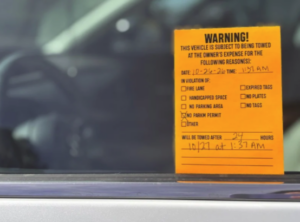
A good parking warning notice answers every question a driver will ask before they reach your office. If it doesn’t, your team will answer those questions in person, one resident at a time.
Put these on every notice:
- The vehicle. License plate, plus make and color if your team can see them.
- Where and when. The space or area, and the date and time the car was seen.
- The rule. Name it plainly: “No permit on file,” “Parked in an assigned space,” “Guest permit expired.”
- What happens next, and when. “This vehicle may be towed at the owner’s expense if it’s here after 6pm on Friday” is clearer than “Further violations may result in enforcement.”
- How to fix it. Register the car, buy a guest permit, or move it. Give the link or the QR code.
- Who to contact. A phone number or email that someone actually answers.
- Who placed it. Your onsite team or your enforcement partner, by name.
In some states, the windshield notice isn’t just a courtesy, it’s part of the legal process. Texas, for example, spells out what a windshield notice has to say when a property uses it as notice before a tow (Texas Occupations Code 2308.252). It has to state that the car isn’t authorized to park there, describe the other unauthorized areas, warn that the car will be towed at the owner’s expense if it stays, and give a phone number answered 24 hours a day. Most communities rely on posted signs instead, but it’s a good model for what any warning should carry.
Pro Tip: Print the date and time a car can be towed on the notice itself instead of “within 24 hours.” A resident who reads it on Saturday morning shouldn’t have to guess when the clock started.
Stickers, tags, or letters: which warning should you use?
Use the least damaging notice that still reaches the driver. For a resident, that’s usually a message with their name on it. For a car you can’t identify, it’s a notice on the windshield that comes off easily.
| Warning type | Works best for | Watch out for |
|---|---|---|
| Adhesive parking warning sticker | Cars you can’t identify, repeat offenders | Hard to remove, damage complaints, and a few states limit where it can go |
| Non-adhesive tag or windshield notice | First warnings on any car | Can blow away, so it’s harder to prove it was left |
| Letter, email, or text to the resident | Residents with a registered car | Only reaches people you can identify by their vehicle |
Adhesive stickers are the most visible option, and that’s the problem. Residents scrape at them with keys and credit cards, and some come to the office asking who will pay to clean the glass. A few states also restrict where a sticker can go. In Maine, it’s a traffic infraction to put a sticker on the windshield of a trespassing car if it would block the driver’s forward view (Maine Revised Statutes 29-A §2082). If you use stickers at all, keep them out of the driver’s line of sight and save them for cars that have ignored a first warning.
Picture a 180-unit community where the onsite team tags every unregistered car with a bright orange sticker. Within a month, three residents ask the office to pay for windshield cleaning, and one posts a photo online. The next quarter, the team switches to a removable tag for first warnings and an email to any resident whose car they can identify. Complaints about the notices stop. The cars still move.
The escalation ladder, from first warning to tow
An escalation ladder is a short, written sequence of steps your community follows every time a car breaks the parking rules. It turns “we tow people sometimes” into a process residents can predict and your team can defend.
| Step | Who does it | What gets recorded |
|---|---|---|
| 1. Policy and notice before enforcement starts | Your onsite team, or monitoring partner | The policy, the signs, the date residents were told |
| 2. First warning | Your onsite team or enforcement partner | Plate, location, date, time, rule broken |
| 3. Final notice with a date | Your onsite team or enforcement partner | The deadline and how the driver was told |
| 4. Boot or tow | Your enforcement partner, as your policy and state law allow | Who authorized it, when, and why |
1. Tell residents the rules before you enforce them
Put the parking policy in the lease or a parking addendum, post signs that meet your state’s requirements, and tell residents when enforcement starts. Give them time to register first. Our guide to towing from private property covers the sign and notice rules state by state.
2. Give a first warning
The first warning is for the resident who forgot to update a plate, the guest who didn’t know the rules, and the new move-in who hasn’t registered yet. Most problems end here. Make the notice specific and give the driver a real way to fix it.
3. Send a final notice with a date
If the car’s still there or comes back, send a final notice that names the deadline: “This vehicle will be towed at the owner’s expense if it’s parked here after 9am on Monday, October 12.” For a resident, send it to their email or door as well as the car.
4. Boot or tow, and only then
If the final notice is ignored, your enforcement partner boots or tows the car under your policy and your state’s rules. ParkM recommends warnings first, then one or two well-chosen tows. Word travels fast in a community. Once residents see the rule enforced fairly, most of them start following it.
What can be towed immediately
Some violations can’t wait for a warning. Many communities tow right away for a car parked in a fire lane, blocking a driveway or a dumpster, in an accessible space without a placard or plate, or in another resident’s assigned space. State law sets the limits here too. Colorado, for example, generally requires 24 hours’ written notice on the windshield before many tows from a parking lot, but exempts a car parked in a resident’s designated space or in a lot marked for residents and their invited guests (C.R.S. 40-10.1-405, covered in our towing from private property guide). Write your immediate-tow list into the policy, so nobody on your team has to decide in the moment.
Pro Tip: Decide how many warnings a car gets, write the number into your policy, and use it for everyone. When one resident gets a warning and another gets towed for the same thing, the complaints pile up fast. It’s one of the parking policy mistakes communities make most.
Want to see who does what at each step? Read how parking enforcement works with ParkM.
Can an apartment community issue parking citations or fines?
Not in the way a city does. A private community can’t issue a government parking ticket. What some communities call a “citation” is really a lease violation notice, and any fee attached to it is only as enforceable as your lease and your state’s landlord-tenant law make it.
That leaves three practical points:
- A fee needs a lease term behind it. If your lease or parking addendum doesn’t name the fee, you’ll have a hard time collecting it. Some states limit what fees a landlord can charge at all, so have your attorney review the clause before you rely on it.
- Guests never signed your lease. You can’t bill a guest for breaking a rule they never agreed to. For a guest or a stranger’s car, the boot or the tow is the remedy, after a warning.
- Fines that become a revenue line backfire. Some vendors pitch citations as a softer alternative to towing that also brings in revenue. The soft part is right: a warning is fairer than an instant tow. But once residents think the fees are about money, they read every notice as a money grab, and they say so in reviews.
The goal of a warning is a car that’s parked correctly tomorrow. A lot where residents register and follow the rules does more for your NOI than a stack of collected fines, because it cuts the staff time spent on disputes.
Boot or tow: which is the better last step?
A boot keeps the car on your property and gets the driver moving again quickly. A tow clears the space. Many communities boot for a repeat offender who lives there, and tow when the car is blocking something or nobody claims it.
| Boot | Tow | |
|---|---|---|
| Where the car ends up | Stays on your lot | A storage lot, often across town |
| What the vehicle owner has to do | Call the boot company and pay to remove it | Find the storage lot, get there, and pay |
| Does it free the space? | No | Yes |
| Best for | Repeat violations by a known resident | Blocked access, fire lanes, assigned spaces, unknown cars |
| How residents usually react | Annoyed, but it’s over quickly | Angrier, and more likely to dispute |
Booting has its own rules, and several states regulate it alongside towing. In Colorado, the Public Utilities Commission oversees both. In Texas, a property can boot an unauthorized car only if compliant signs have been posted for at least 24 hours. The boot operator has to leave a notice on the windshield or driver’s side window with the date and time, the company’s contact details, a 24-hour phone number, and the removal fee. It must also remove the boot within one hour of the owner’s call, or waive the removal fee (Texas Occupations Code 2308.257 and 2308.258). Cities can add their own booting rules on top.
Ask whether your enforcement partner offers both. Our guide to choosing a towing company for apartments covers what to put in that agreement.
Why each step needs a record
A record turns a dispute from your word against theirs into a short conversation. A tow that follows two dated warnings is hard to argue with. A tow nobody can explain is the one that ends up in an online review.
Picture a resident at a 240-unit community who’s towed on a Thursday night. On Friday morning she’s at the desk, sure she was never warned. The manager pulls up the car’s history: a first warning on the 2nd, a final notice on the 6th with a Thursday deadline, and the tow request at 10:40pm. She still isn’t happy, but the conversation is over in ten minutes. Without that record, it takes the whole morning and probably ends in a refund.
Here’s how ParkM helps you keep that record without adding paperwork:
- ParkM timestamps and documents every enforcement action, a warning as much as a tow. Your team sees that history in the property manager portal.
- ParkM flags residents with repeated warnings, so you can talk to them before a tow becomes the only option left.
- Your team can request a tow for a specific vehicle from the portal, so the request itself is on the record.
- Your enforcement partner can see each permitted car’s plate and the last six digits of its VIN (for residents), so there’s more than a plate to go on when a plate may have been typed wrong.
- A no-tow list keeps staff, vendors, and anyone else you’ve cleared off the tow truck.
- The permit list stays current. Residents register and swap cars online 24/7, a permit is live the moment it’s bought, and ParkM sends expiry reminders by email and text. Your team sends fewer warnings to cars that should have been fine.
ParkM doesn’t issue warnings or tow cars. Your community sets the rules and keeps its own enforcement partner, and that partner places the warnings and does the towing or booting. ParkM keeps the permit list and the record of each step.
Tina Pike, Property Manager at Sofi Belmar in Colorado, described how that works across a team: “Their team worked closely with both our onsite staff and towing company, and whenever changes to parking or towing laws affected our operations, they made sure we understood what was changing before it went into effect.”
Pro Tip: Once a month, pull every tow from the last 30 days and check that each one had the warnings your policy promises. If one didn’t, find out why before a resident does.
Want to see the warning history and tow requests in the portal? See how ParkM works.
Questions property managers ask about parking warnings
Do apartments have to warn before towing?
It depends on your state and your own policy. In many states, a posted tow-away sign is the legal notice, so no separate warning is required. Others ask for more: Colorado requires 24 hours’ written notice on the windshield before many tows. And if your lease or policy promises a warning, residents will hold you to it.
Can we put a warning sticker on a car’s windshield?
Often, yes, on your own property. But adhesive stickers lead to damage complaints, and some states restrict them. Maine bars a sticker that blocks the driver’s forward view. A removable tag or a message to the resident does the same job with less friction.
How many warnings should a car get before it’s towed?
There’s no single legal number in most states. Many communities choose one or two warnings plus a final notice. What matters most is that you pick a number, put it in the policy, and apply it to everyone the same way.
Can we charge residents a fine for a parking violation?
Only if your lease or parking addendum includes the fee and your state’s landlord-tenant law allows it. Have your attorney review the clause. Guests haven’t signed your lease, so a fee rarely works for them.
Does ParkM issue parking warnings or tow cars?
No. Your community sets the rules, and your enforcement partner places warnings and tows or boots cars. ParkM keeps the permit list current and records each enforcement action, so you can see what happened and when.
Where this leaves you
Warning notices are where fair enforcement starts. Tell residents the rules, warn before you tow, give a final notice with a date, and keep a record of every step. You’ll field fewer disputes at the leasing desk and spend less staff time untangling them.
Here’s the part your owners will like: ParkM doesn’t add a line item to your budget. Residents and guests pay for their own permits, so you get a better-run lot without a new expense. And ParkM is confident enough in the accuracy of its verification technology to cover the cost of a wrongful tow, plus storage fees up to 24 hours. See the no-bad-tow guarantee.
Book a demo to see how ParkM keeps your permit list current and every enforcement step on the record.