LPR parking enforcement for apartments, with no cameras to install
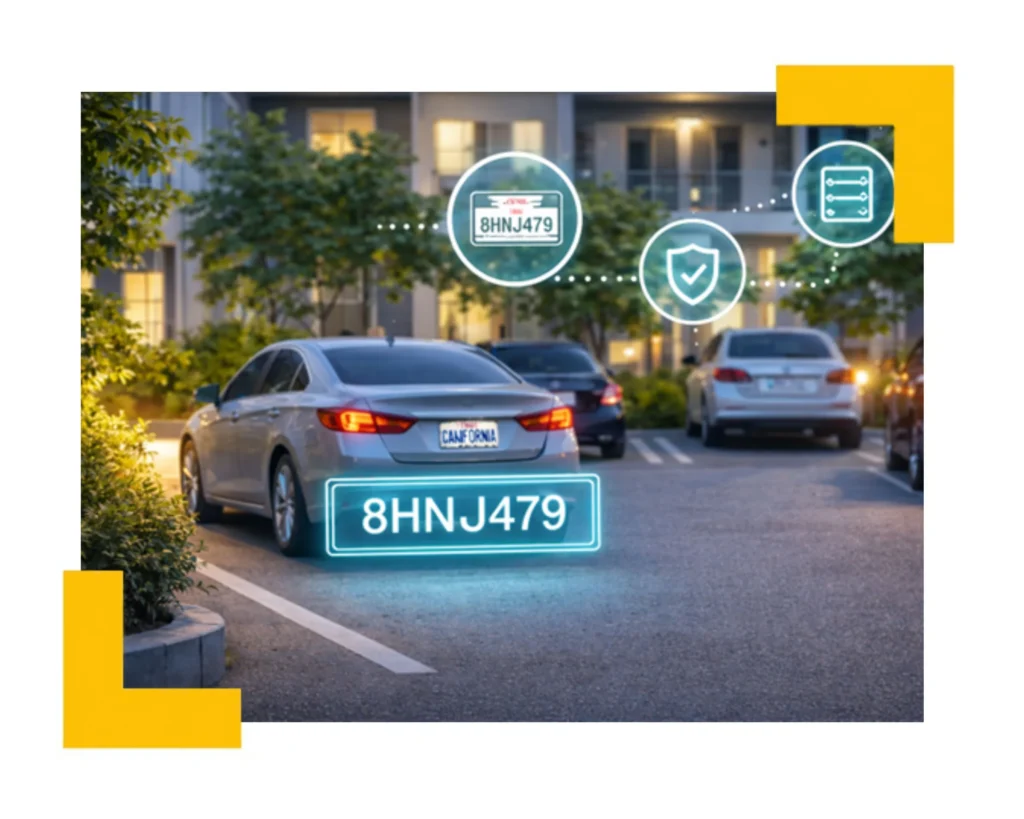
Depending on what state you live in, your enforcement partner probably already drives your lot. With ParkM, their phone reads each license plate and checks it against your community’s live permit list. So the answer to “does this car belong here?” comes from a record instead of a hang tag or a printout.
Nothing is installed at the property, so there are no cameras or gates to maintain. ParkM costs the property nothing, because the vehicle owner pays for the permit.
"Whose car is that?" LPR parking enforcement answers that question
Whether you run one community or a portfolio, most parking complaints that reach the leasing office come down to one question: is that car allowed to be there?
With stickers and hang tags, the answer depends on something that fades, falls off the mirror, or moves to a friend’s car. With a printed list, it depends on when the list was printed. A resident who registered this afternoon isn’t on it.
So the person making the call in the lot at night is working from a best guess, and your team hears about it in the morning. That’s staff time spent on a dispute, and a resident who trusts enforcement a little less.
License plate recognition parking enforcement takes the guess work out. The plate is the permit, and the plate is what gets checked.
HOW IT WORKS
How LPR parking enforcement works with ParkM
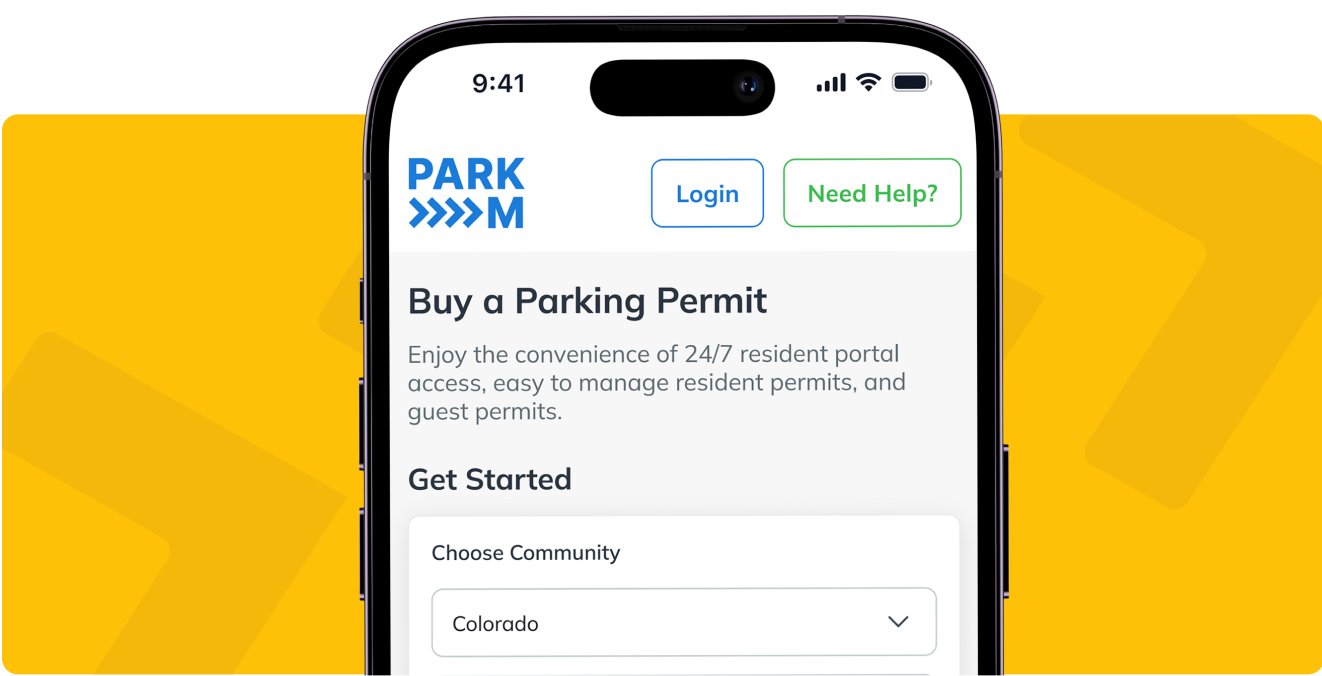
- Residents and guests register online. They buy a digital permit at parkm.app from a phone or computer, with no app to download. ParkM records the license plate and the last six digits of the VIN.
- The permit is live immediately. It counts from the moment it’s bought, so there’s no overnight gap where a resident who’s paid can still be towed.
- Your enforcement partner patrols with their phone. LPR is built into ParkM’s enforcement app. As they scan plates from their vehicle, each car comes back red or green against the live permit list.
- A red result can get a second check. Before any tow, your partner can verify the last six digits of the VIN against the vehicle itself.
- Every action is recorded. Each warning and each tow is timestamped, documented, and saved to the property manager portal.
The rules behind a red result are yours. You decide which permit types exist, how many vehicles a unit can register, and how many nights in a row a guest can stay. The plate check applies those rules the same way to every car in the lot.
For the longer walk-through of permits, launch and grandfathering, see how ParkM works.
Mobile LPR on a phone, compared with cameras on a pole
When most people hear “license plate reader,” they picture a camera bolted over a garage entrance. That’s one way to run LPR, and it’s a different setup from ParkM’s.
| Fixed LPR cameras | ParkM’s LPR | |
|---|---|---|
| Where the reader is | Mounted at an entrance or exit | In the enforcement web-app, on your partner’s smartphone |
| What is installed at the property | Cameras, mounting, power, and a network connection | Nothing |
| Which vehicles it reads | Vehicles passing the point the camera faces | Parked vehicles, anywhere your partner drives in the lot |
| When it reads | Around the clock, at that one point | Whenever your enforcement partner patrols |
Fixed cameras suit a property that wants every entry at a gate logged day and night. At many apartment communities, though, the problem is a car parked in a space it has no right to, and the way to find it is to check the parked cars. A reader that travels with the patrol does that without a construction project.
Phone-based plate reading is common in multifamily parking software. When you compare vendors, the useful questions are how they verify a vehicle is valid for tow, and what has to happen before a car is moved.
Why a plate read alone is not enough to tow
Plate readers can make mistakes. A dirty or missing plate, a bent frame, or a B that reads as an 8, and a resident who paid comes back as unauthorized.
That’s why a red result is not a tow order on its own. At signup, ParkM records the last six digits of each vehicle’s VIN, and your enforcement partner has the ability to check them against the car before it’s towed. For a misread plate, ParkM’s near-match feature flags close matches, such as a B read as an 8, so your partner can review them before acting.
That verification is what ParkM puts its money behind. ParkM is confident enough in the accuracy of its verification technology to cover the cost of a wrongful tow, plus storage fees up to 24 hours. The details, and how a property makes a claim, are on the no bad tow guarantee.
“Before ParkM, we were dealing with parking and towing issues that created unnecessary frustration for both our team and our residents. Since making the switch, the registration process has improved, parking operations have become easier to manage, and the number of parking-related problems has decreased.”
Stephanie Coats, Property Manager, Lenox Cooper Apartments, TX
LPR checks the plate, and your tow company still makes the tow
ParkM isn’t a tow company and doesn’t replace yours. The property sets its enforcement terms directly with its own towing or booting partner, and that partner patrols, reads the plates, and moves a vehicle when your rules call for it.
ParkM’s part is the permit list the phone checks against, the record of every action, and the calls from residents and guests about their permits.
Your partner doesn’t need new equipment, only their own phone. We train your enforcement partner on the app as part of the launch process. If your community doesn’t have a towing partner yet, ParkM can suggest one from its list of preferred vendors.
For the full split of who sets the rules, who checks, and who tows, read parking enforcement services for apartment communities.
What you see from the property manager portal
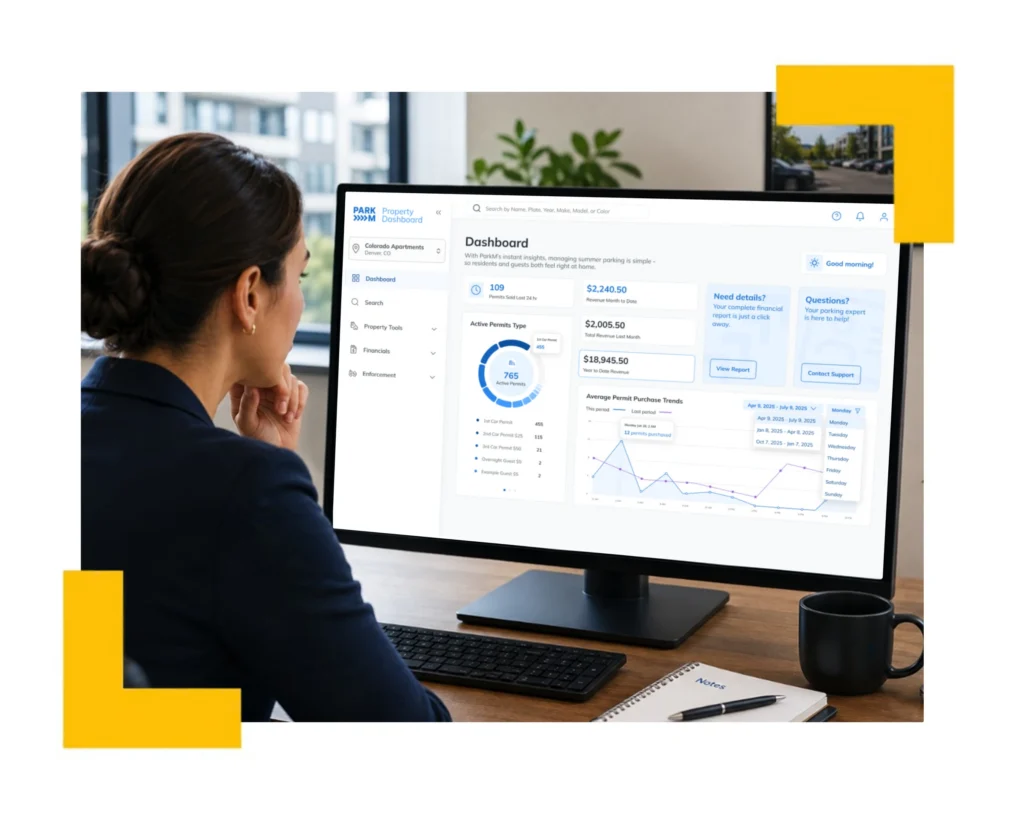
The plate check happens in the lot. The record of it lands in your portal, where you have:
- A real-time dashboard of active permits, vehicles, and enforcement actions.
- Enforcement history with timestamps, so a disputed tow is settled from the record rather than from memory.
- Compliance flags for residents with 3 or more warnings.
- A no-tow list for staff, vendors, and anyone else you name.
- Plate blocking, for a vehicle that should no longer be on the property.
- Tow requests sent directly from the portal when your on-site team needs a vehicle moved.
Warnings usually come first. ParkM’s recommended sequence is warning notices before any tow, then a tow when the rules keep being ignored. You and your enforcement partner set the terms on escalation.
The ParkM enforcement portal your partner uses shows vehicle and permit data only, which is what a plate check needs.

What LPR parking enforcement costs the property
Nothing. ParkM is free to the property: no cost to the property and no monthly billing to the property. The vehicle owner pays for the permit, and that’s what funds the software, including the LPR in the enforcement app.
Whatever you pay your tow company today is a separate arrangement, and it doesn’t change.
Questions property managers ask about LPR parking enforcement
Do we need to install cameras or other equipment?
No. LPR is built into ParkM’s enforcement app and runs on your enforcement partner’s smartphone. Nothing is mounted at the property, and there’s no gate or reader for your maintenance team to look after.
Does ParkM tow vehicles?
No. ParkM doesn’t tow, boot, or patrol. Your own towing or booting partner does, under the terms your property sets with them directly. ParkM provides the live permit list your partner checks against, the VIN on file for a second check, and a timestamped record of every enforcement action.
What happens if the app misreads a plate?
ParkM flags it for review. A near-match feature runs on every plate search, so close matches, such as an O read as a 0, show up for your partner, who can also check the last six digits of the VIN against the car. If a vehicle is towed wrongly anyway, ParkM covers the cost of the tow, plus storage fees up to 24 hours.
Can our current tow company use ParkM's LPR?
Yes. ParkM doesn’t ask you to switch. Your partner uses ParkM’s enforcement app on their own phone, training on it is included in launch, and their agreement with you stays as it is. If you don’t have a partner, ParkM can suggest one from its preferred vendor list.
Do residents need to download an app?
No. Residents and guests register their vehicle and buy a permit online at parkm.app, from a phone or a computer. Their license plate becomes the permit, so there’s nothing to hang on the mirror and nothing to install. ParkM handles resident and guest questions about permits, so your leasing team doesn’t have to.
How are guests' cars handled?
A guest permit is tied to the guest’s plate, and either the guest or the resident can buy it. While it’s valid, the car checks green like any resident’s. You set how many guest permits are allowed, per unit and across the property, and how many nights in a row a guest can stay, so guest parking doesn’t turn into overflow resident parking.
See the plate check your enforcement partner would use
In a demo, ParkM can walk you through the enforcement app, the VIN and near-match checks before a tow, and what your portal shows the morning after. Bring your questions about your tow company and the parking rules you already have.
No cost to the property. No contract, 30 days notice.