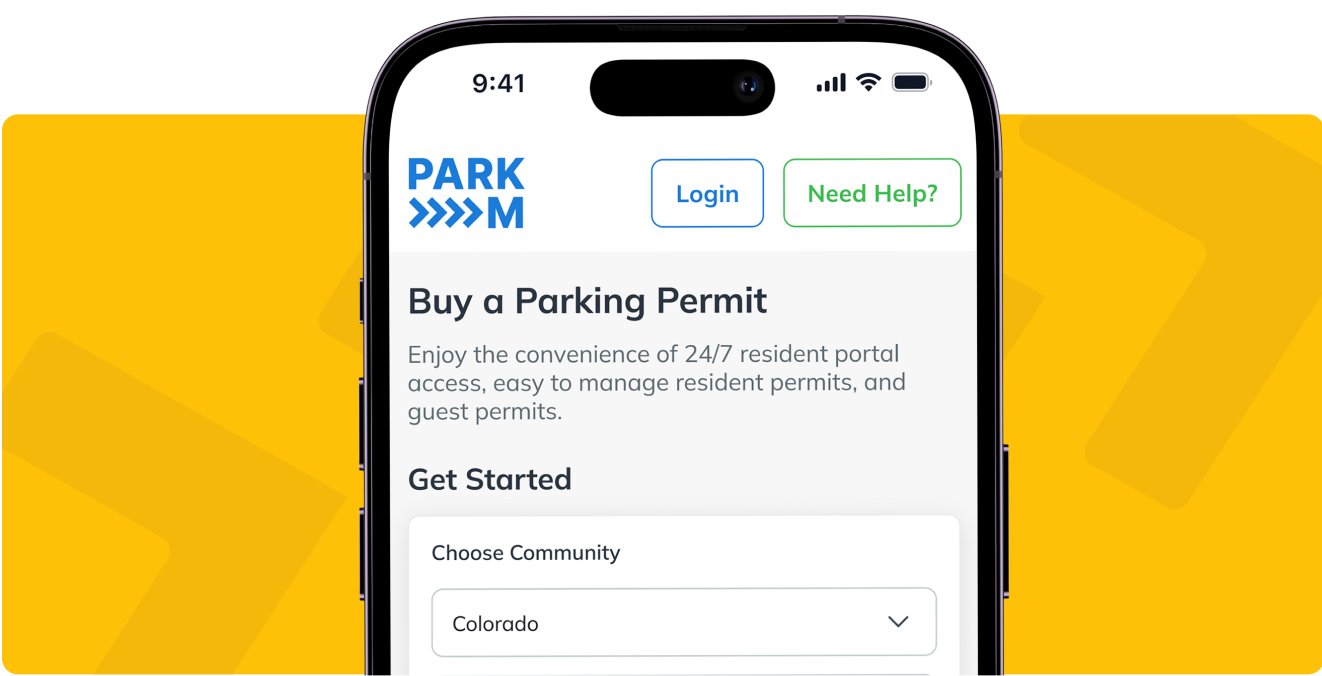
ParkM gives Arizona apartment communities digital parking permits where the resident’s license plate is the permit. There are no stickers or hang tags, it costs the property nothing, and your own tow company keeps enforcing. This page covers what is specific to Arizona: what state law requires before a tow, and how permits fit around it.
What does Arizona law require before a tow from apartment parking?
Towing from private property in Arizona is governed by A.R.S. 9-499.05. It sets three things a property manager has to get right before a single car leaves the lot.
Signs, or the lot is treated as open to the public. Unless a parking area is posted, the statute treats the owner as having consented to unrestricted parking by the general public. The signs have to be clearly visible and readable from any point in the parking area and at each entrance, and they have to state at least:
- The restrictions on parking.
- What happens to a vehicle that breaks them.
- The maximum cost to the violator, including storage fees and any other charges.
- A telephone number and an address where the owner can find the vehicle.
Written permission, from you and not from the tow company. A private towing carrier may tow from your lot only at the request of law enforcement, or with express written permission from the property owner or the owner’s agent, and only once the signs are up. The owner or agent either signs each towing order or authorizes tows under a written contract that runs for a specific length of time. The statute is explicit that the tow company may not act as your agent. A carrier that tows without that permission commits a class 2 misdemeanor.
Your city can cap the price. An incorporated city or town may set the maximum rate for towing from private property inside its boundaries. Check the rules for the city your community sits in before you print the cost line on your signs.
This is a summary of the statute, not legal advice. Your attorney and your tow company should confirm what applies to your property.
Where digital permits fit around Arizona’s rules
The statute decides whether a tow is allowed at all. The permit list decides whether one particular car should be towed, and that is where wrongful tows often start: a permit that was paid for but not yet on the list, or a plate read one character off at the back of the lot.
- A permit is live the moment it is bought. The list your enforcement partner checks is current at the moment of the check, not the morning it was printed. Residents and guests buy and manage permits at parkm.app, 24/7, with no app to download.
- Your enforcement partner reads plates from a smartphone, using the license plate recognition (LPR) built into ParkM’s enforcement app. There are no cameras or equipment to install.
- Plate and VIN on file. Signup captures the plate and the last six digits of the VIN, and the tow operator can check both against the vehicle before towing. ParkM’s near-match search also flags a plate that may have been misread, so your partner can review it before acting.
- Every enforcement action is timestamped and documented, which is the record you want in front of you when a resident disputes a tow.
- ParkM covers the cost of a wrongful tow, plus storage fees up to 24 hours.
Two things stay yours. ParkM includes 10 parking signs with your community’s own QR code, so a guest can buy a permit standing in the lot. Those are permit signs. The tow-away signs A.R.S. 9-499.05 requires are a separate item, and posting them stays the property’s responsibility. And ParkM is not a tow company: you set enforcement terms directly with your own tow or boot company, and ParkM tells them which plates are authorized. For how the rules differ in Texas, Florida, California and Colorado, see our guide to towing from private property.
How do you keep guest parking from turning into resident parking?
Guest parking is where many apartment lots fill up, and the hardest case is the visitor who stays for weeks rather than a night. If your community sees long winter visits, a guest pass that renews every evening quietly becomes a second resident car.
ParkM lets the property set guest permit daily limits and consecutive-day restrictions, so a long stay has to become a resident permit or end. Guests can buy their own permit, or a resident can buy it for them, at any hour, which keeps the leasing office out of it. Vehicle-to-unit tracking also makes unauthorized occupants identifiable, and the property manager portal shows every active permit and vehicle in real time. Residents who collect 3 or more warnings are flagged, so any escalation arrives with a record behind it.
More on the guest side: visitor parking permits, and our guide on how to stop guest parking abuse.
Covered and reserved spaces
In an Arizona summer, the covered space is the one everybody wants. If your community rents carports or reserved spaces, each can carry its own permit. ParkM’s permit types include resident, second vehicle, guest, reserved and public, and the property sets the rules and the price for each. Permit limits can be set by unit or by leaseholder, so a covered space goes to the household it was assigned to.
Does ParkM cost an Arizona property anything?
No. ParkM is no cost to the property, with no monthly billing to the property. The vehicle owner pays for the permit, and ParkM shares the revenue with the property. There is no contract, just 30 days notice to cancel.
Switching does not mean charging existing residents overnight. With grandfathering, your current residents enroll for free and only new move-ins are charged, so the rules do not change mid-lease. See how a ParkM launch works.
ParkM is built for apartment communities. Condo and HOA associations are set up differently, so ask us what fits before you plan a rollout.
Support on Arizona time
Support is US-based and live, 5am to 10pm Mountain Standard Time, seven days a week. ParkM answers residents and guests directly, so their parking questions do not land on your leasing office. From March to early November, that window reads 4am to 9pm on an Arizona clock. In winter the two match.
If you manage more than one community, one login covers them all, and leasing agents can get their own access without seeing the financials.
What do you need to get started?
Only a unit directory and a launch date. A dedicated launch coordinator takes it from there, with pre-written resident communications and training for your staff and your enforcement partner.
ParkM runs the same way at every community it serves. For the national picture, see ParkM’s apartment parking solutions, the parking management solutions for property managers, the apartment parking management software behind them, and how virtual parking permits replace stickers and hang tags.
Book a demo and bring your parking rules. We will show you how they run in ParkM at your Arizona property.